(Anyone who is currently in my campaign *cough* *cough* Mathew S. please stop reading now!)
Okay, now that I have gotten that out of the way I can talk to the rest of you. I have recently begun a new campaign with my players. We tend to rotate DM's every 4-6 months and each DM gets to start a new campaign.
As I usually do when I sit down to start a campaign, I look at the bookshelf of RPG products that I own to see what I want to use. I rarely use anything wholesale or without modification, but always use something as I don't have the time to create everything from scratch.
I had two vague ideas of what I wanted to do. The first being that I wanted to do a mega-dungeon. I like that style of play and wanted to experiment with it more. The second that I wanted to create the encounters myself rather than running a premade megadungeon.
For each session I'd prep a little 10-15 room section of the megadungeon. The first week would be a bit more week as I'd have to prep the first section plus whatever sections lead off from it. But overall I'd prep the megadungeon in a very modular way where I'd only ever be one step ahead of the players. This would allow me to kind of create content that followed up on whatever the players found interesting.
But overall I still needed a world/setting to 'skin' or theme the megadungeon as I wanted it to be something a bit more than just a generic underground complex.
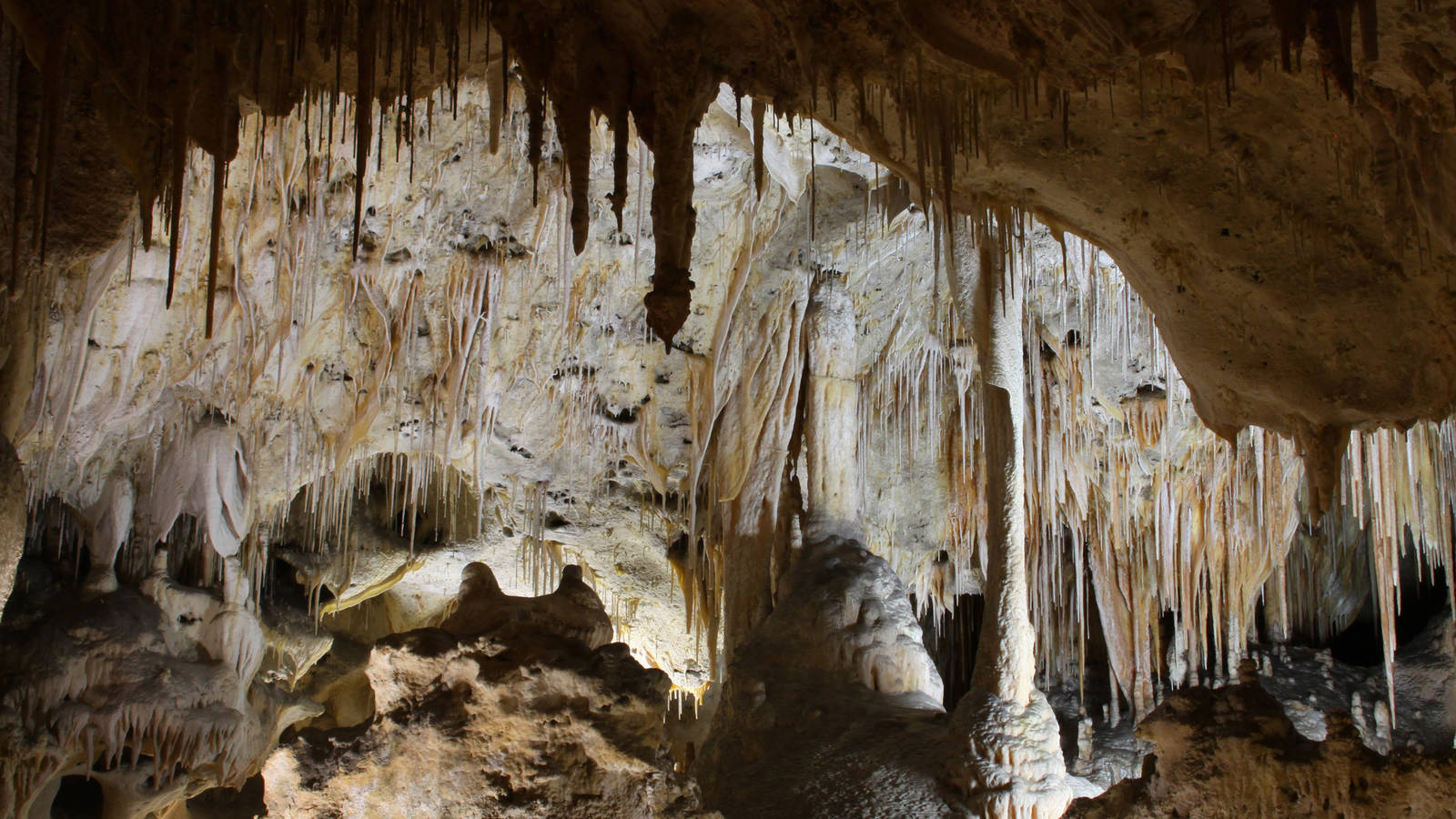
I have decided to use Veins of the Earth for this purpose. Mainly because I really, really love Veins of the Earth. I read it initially when it came out but then recently went on a trip to New Mexico where I got to visit Carlesbad Caverns. It was a truly amazing surreal and awe inspiring experience, I highly suggest that anyone who has the chance to go visit them. So overall I had caves on the mind.
Veins of the Earth doesn't have a strictly presented default style of play. But adapting it to be more of a megadungeon would involve hacking it in some ways. To this end I have decided to blog about it because, while I have read a lot of reviews about it and how amazing it is, I don't think I've seen any play reports or reports of how people made use of it in actually running a game.
And so we begin!
The Endless Descent...
One theme that I really loved about Veins in the Earth was the whole idea of the endless descent.
There is only the infinite darkness. But not the infinity of outer space, the infinity of endless cofined caverns, each a cloistering chamber, like room in a maze. Time has no meaning; dust could cover the floor, you could find a skeletal body with the trappings of those who lived 1000 years ago; the fossilized remains of something that lived a million years ago; or you could find freshly spilled blood, hear someone's last gasp echoing amid the rock. There is no regularity or consistentcy to time.
Space also has no meaning. Caverns go up, down, twist about, sometimes back upon each other. It's hard to know if you are heading towards a dead end, heading towards where the rock just gets narrower and narrower until you can't continue on but you see it continue before you like the tunnel of an ant. There is a strange dichotomy in caves: that sense of the endless, that each cavern you explore is another passageway, another space, stretches out endlessly; and a sense of the claustrophobic. It is very easy to get lost, very easy to forget that you are deep within the earth, that while the cavern may stretch out before you and seem endless, it is not the openness of outer space. Stone is unforgiving, unyielding.
There is only the descent. Further, further, into the caves you go, sometimes up, sometimes down. The only point of reference you have is yourself, what you see, what you feel, what you sense or don't sense. You descend, down, down, down, what unknowns await you, you never know. The only way is forward, and to move forward is to move forever down. Past all structure, man and civilization has conceived for itself, deep into the bedrock of time itself.
It was these themes, presented in the book, and from my own experiencing exploring Carlesbad Caverns, that I wanted to capture with my campaign.
Cave System Generation Rules
In Veins of the Earth there are two different sets of rules presented for creating and traveling in caverns. One is a set of rules that creates a 'player level' cavern systems. Basically a grouping of caves that the players can explore. Like the weekly mini-dungeon or whatever. The other set of rules creates a more birds-eye-view wilderness type map that the players can use to travel across vast sections of the underdark.
To create my megadungeon I decided to use just the rules involved with creating cavern systems and ignore the birds-eye-view rules. I've modified the cave system generation rules a bit. I'll probably post it at some point when I refine them a bit more. Overall, as mentioned a bit in the above, I would be creating the megadungeon in a modular way. Each cavern system would have 3d6 caves and have a name/theme etc. Additionally each would essentially be the lair of one of the monsters presented in the first half of Veins of the Earth. It wouldn't necessarily be the only monster or enemy that the players would encounter in that cave system. But it would be the apex predator, where while they were in that system they would be on it's turf.
In essence in my underdark, there is no 'wilderness' in how we commonly think of wilderness in RPGs. There are only endless interconnected systems of caves. A natural megadungon.
Cities and Civilization
Another thing that I wanted to change is how Veins presents cities and civilization. I didn't want the underdark just to be a upside down or shadow version of the surface. On the surface you have cities and villages and various peoples and a whole social structure. I didn't want cultures/civilizations to be arranged in a similar manner below where you'd have underground cities in vast caverns and trade tunnels instead of trade roads and stuff like this.
The reasons for this are twofold. The first being that from a realistic point of view, it would be near to impossible to have underground cities. Due to the unique geography of caves, from a social and survival point of view, things would develop dramatically different. The most you could probably have are small bands of people. Things would be much, much more tribal.
This fit well with my megadungeon idea. Where above all else I wanted the overall impression the players got, was to be of that of the
mythic underworld, of
endless descent. It's kind of hard to have the game embody this feeling if the players stumble across an underground city. The caverns begin to feel a bit less unknown and unmapped, a bit less wild and strange. Additionally, in megadungeons there are often different factions living in the mega-dungeon that the players can interact with. The idea of having no cities and instead scattered tribal groups of 5-15 individuals, who in a way are a lot like the players, exploring the underdark and trying to survive, fit well with this concept. The only difference between them and the players is they will have either simply been born in the underdark or been there much longer than the players.
Cultures and Races
It may seem natural to have the six cultures presented in Veins of the Earth to be the peoples that form the small tribal groups that are encountered. I decided against this.
The main reason I decided against it is that most of the prevailing mystery around megadugneons is who built them and how they came about. Where you delve deeper and deeper into them to find what lies at it's center, to find some answers to all the weird shit that seems to fill them.
With my underdark serving as a natural megadungeon, there would have no such 'builders'. I still needed some source of mystery though. Something or someone that would make the players want to continue delving to find out if they hold the they seek.
The main cultures presented in Veins of the Earth seemed to fit really well for this. They are presented in a really vague way that make them seem alien. They are also the masters of the underdark. They are the intelligent life that has survived the longest in it and adapted to it the most.
They would serve as my metaphorical 'builders' of the megadungeon. Additionally, they would also likely know routes back to the surface if the players wanted to find their way back there. While there is no explicit or set goal of the megadungeon, if the players wanted to answers to the mysteries they encountered while delving, they'd have to seek out one of these races.
In this manner meeting one of these races would serve as the endgame for the megadungeon. As to what the meeting will entail or what the players hope to get out of it, or even which race they hope to meet up with, it's up to them.
So while they will encounter tribal groups in the underdark, none of them will be made up of the main cultures presented in Veins. Instead they will be made up of the more intelligent monsters, like the Funginoids, the Knotsmen, the Olm, etc. Or even other more solitary monsters as I tend to run my games where interaction besides combat is generally possible with all but the most dangerous or violent monsters.
The cultures presented in Veins instead would be presented in fleeting glimpses. Strange items found, escaped slaves who are insane, strange marking and writings, shadowy figures seen who appear to be watching, basically fragmented events or encounters which only serve to heighten the mysteriousness and utter alien nature of these cultures.
Keeping direct contact and interaction with them as limited as possible until the endgame also helps to keep them alien. It's kind of hard to have something that the players encounter frequently; in combat, in parley, getting quests from, doing errands for, as alien. I'm going with the less is more approach.
The 4 Cultures
In the end I decided on using four of the six cultures presented in Veins. The main reason is that four seemed a bit more manageable and some of them seemed to leand themselves more towards the less is more approach than others. I also wanted them to strongly contrast them against each other and four kind of fit well along the whole, good/evil/law/chaos divides that most RPG players know well. Having them contrast each other would force the players to make a meaningful decision about which race they'd like to try to contact and which they feel might be most likely to meet their objectives.
In order to have them encountered indirectly, rather than directly, I have modified the following four cultures in the following ways so I have more to work with in terms of dropping hints, shadowy encounters, signs and foreshadowing, etc.
dEr0
As presented in the book the dEro are paranoid dwarf like creatures skilled in strange, almost steampunk like technology, except heavily focusing on crystals and diamonds and other minerals and electricity rather than brass and steam. The players will find bits and pieces of their technology and gadgets scattered about. Periscopes watching them, be attacked by strange experiments gone wrong, find horribly mutilated and abused test subjects. Kind of like your mad scientist sterotypes with paranoia cranked up to 11. Like an
Island of Dr. Monreau or
Mysterious Island type situation.
As for the endgame what other fantasy creature tends to be solitary, is incredibly powerful, and often works it's will through intermediaries. Lichs! Often in their incredibly dangerous lich lairs which are mazes of deadly traps.
Except instead of a Lich it's a dEr0. They're so paranoid they're inherently solitary (they trust other dEr0 the least of all) and build their lairs to protect themselves. Instead of having access to powerful magic, it's strange and alien technology. If the players want to talk to one thy are going to have to reach one at the center of it's deadly lair. Which will be an exercise in deadly mindgames as the dEr0 probably wants people to test it's defenses. So you kind of get around that whole problem of why the fuck would somebody build a deadly maze only to bait people into it problem that most deadly dungeons have.
Imagine the dEr0 watching their progress and shouting at them constantly through some kind of intercom while they delve into it's maze.
"AHA! YOU HAVE SURVIVED MY ELECTRIFIED FLOOR PANELS! I WANTED YOU TO SURVIVE MY ELECTRIFIED FLOOR PANELS. THANK YOU FOR TESTING MY ELECTRIC FLOOR PANELS. WHEN YOU WAKE UP FROM THE SIMULATION YOU WILL BE REWARDED. I AM NOT THE dEr0 YOU SEEK. I AM PART OF THE SIMULATION. THE OTHER dEr0 ARE PART OF THE SIMULATION. I AM THE OTHER dEr0. IF THE OTHER dEr0 SENT YOU THEN YOU ARE FAILING THE SIMULATION. HOW CAN YOU NOT PERCEIVE YOUR FAILURE OF THE SIMULATION. THE SIMULATION SIMULATES FAILURE TO SEE HOW THE SIMULATION CAN FAIL. YOU WILL FAIL THE SIMULATION. YOU MUST FAIL THE SIMULATION TO WAKE UP. THE SIMULATION CANNOT NOT FAIL."
Aelf-Adal
As they are presented in the book the Aelf-Adal in my underdark are elven creatures of immense hatred that is so self-contained it is as capricious as it is cruel. They are as likely to laugh their cold laughter, like the twinkling of sliver bells, as they are to slit your throat. Their motivations are utterly chimerical. They seem childlike in nature but are even more alien that this for even children have understandable, base motivations. The Aelf-Adal do not.
They are creatures of pure shadow. You don't hear or see them first. You sense them. Sense an immense hatred. It falls upon you oppressively. You look around lifting your lantern high, half expecting to see someone staring at you out of the darkness, or behind you, but there is no one.
Sometimes this presence of immense hatred leaves and they are gone. Sometimes it stays, and you hear laughter like a cold sun that sends shivers down your spine. Sometimes you see darkness fluttering on the edge of your vision, like when you turn your head too fast and the image blurs. Someone falls down dead, their throat slit, a monster that you were fighting is disemboweled, a pile of pure white diamonds lie on the floor, a strange symbol is drawn in chalk.
The few who know of the Aelf-Adal know that during these moments, instead of looking around for them, if you douse the flame of your lantern, if you stand in complete darkness you can see them. They stand around you as black outlines, silhouettes of a deeper darkness in the black. Tall and elfin in form. You see them. If you talk to them they may answer. They may not. They may just vanish once they realize they are being observed.
The endgame for the Aelf-Adal would probably involve two parts. The first being finding something they desire. Some innocuous or strange item that it seems like no one would want. An ordinary boot on the skeleton of some long dead adventurer. A flower carved out of dimond. A beautiful purple mushroom that grows alone. And then finding some kind of portal or way to travel to their shadow realm so you can parley with their sexless and ageless Queen giving the item in return for something that you want.
Dvargir
As described in the book they are work obsessed. They literally live to work. They build, they construct, and then once it's done they abandon it and move on. It's kind of suggested in the book that they build cities. Instead of cities, in my underdark, they build graveyards; mausoleum cities of the dead.
From birth every single Dvargir works endlessly on it's own tomb. They work until it is complete and then once it is complete they entomb themselves inside, lie down in their sarcophagus and close their eyes until they die. It is only when they lay thus, like the final capstone in an arch, is their work and life considered complete.
Dvargir cities are cities of the dead. Streets laid out, flagstones laid, everything perfectly crafted, everything in perfect symmetry and style. Except instead of rows of houses or buildings you have mausoleums and tombs. Each doorway covered with Dvargir runic equations to protect the bones of those who lie within.
They probably carve their strange runic equations on the bones of lesser creatures to instill the undying will to work in them. To essentially keep them alive and working even when dead. To protect their empty and lifeless cities.
For the endgame the players are going to have to find one of these cities. It probably won't be extraordinarily hard. They're not kept secret. But they are seen as cursed places which are full of all kinds of weird and strange vengeful ghosts and undead. And if they want to talk to a Dvargir they are going to have to remove it's bones from it's tomb and conduct some ritual in the grand temple. A temple that is probably more like a Freemason temple than a church temple, if they want to raise it from the dead.
I'd probably mix in a bunch of weird Masonic stuff into them and their runes to stop their rune magic from seeming too much like viking magic. Make their runes spell out mathematical equations. Mix in stuff like the whole Master Builder thing in Freemasonry and divine or sacred geometry where the universe is seen as being designed with divine proportions and if you can understand the divine math you can harness the power of god or something. They understand this sacred math.
Gnomen
Like in the book in my underdark the Gnomen are going to be free-spirited creatures that tend to live in the moment. I'm going to basically make them like your sprites or faeries of folklore.
They are diminutive in side. No more than 12 inches tall. You also hardly ever see them. Instead like the story about the cobbler where he wakes up every morning and finds all his shoes have been cobbled in the night and then stays up all night to see the faeries doing it and then they disappear and never do it again, the Gnomen are going to be like that.
The players may wake up and find their gear fixed. Or be stuck in a chasm and find a rope unfurling from above to help them but when they climb up find no one there. Or find miniature tools lying about at times. Or miniature clothing. The Gnomen are the only purely good culture of the 4. They'll be helpful to the players but incredibly shy. Only helping them in ways where they can avoid being seen and can probably turn invisible or something.
The endgame for them is they probably need the players to do something. Like their race is trapped or enslaved. Maybe not necessarily physically but they have been bound and enslaved in some way. They yearn to truly be free, to escape their bonds of slavery. But they can't act directly against whatever enslaves them. It's part of the geas upon them. So they have to act indirectly. To kind of do good things for the players and hope the players become interested with them. Give the players signs about their predicament and hope that the players kind of figure it out and solve the riddle that they need to solve to free them and defeat whatever enslaves them.
The Knotsmen
I know I said I'm having only four major cultures that serve as the dungeon 'builders' and a source of the endgame, but the Knotsmen deserve special mention as they will be the glue that kind holds a lot of it together.
Like in the book they are obsessed with debt, never give anything away for free, and inherently untrustworthy, etc. In my undedark they are essentially the main merchants/sources of information. You don't encounter villages of them or even tribes. You only encounter they individually, and never encounter the same one twice (although they look similar). But they all seem to know about your previous encounters and dealings. If you kill one and encounter another, no matter how well you covered up the murder, the next ones will know. They may not care, probably won't care, but they know.
They always travel about on skiffs and are always encountered on bodies of water. Underground rivers, lakes, pools etc. They seem to use these waterways to travel about although it's never seen how and they never offer to take the players anywhere. They always have items for sale or barter, sometimes mundane, sometimes magical, and always information to sell. If the players want to get info about the 4 main cultures, the Knotsmen are an excellent source.
They never give anything away for free. Additionally they refuse to sell or barter anything that the players desire most. No amount of money or promises or anything will sway them. They will only provide what is most wanted for debt: they will give you what you want but someday, someway, they will come to collect upon that debt. What that debt entails is largely ambiguous but if the players roleplay it well enough the Knotsman may agree to conditions. If they agree to conditions they will always try to cheat them. They are kind of like a combination of the devil at the crossroads and
Charon the ferryman.
They probably show up every session or two. As I'm doing the underdark as a megadungeon and the players are stuck in it, there will be no opportunity to exit the megadungeon and go back to the nearby village to rest and buy stuff as there is in most megadungeons. Instead the players are essentially trapped in the megadungeon. The Knotsman can essentially provide the services and actives the players would normally do in town and serve as a reoccurring or familiar point of contact this way.