Saturday, 27 January 2018

The Endless Descent: Rule Changes and Treasure Table

(This is an ongoing blog series about my Veins of the Earth Megadungeon Campaign that I call The Endless Descent. You can read the initial campaign ideas here)


Overall I find most of the rules presented in Veins of the Earth work very well with running it as a megadungeon. However there are a few things I'd like to alter in order to have it work a bit better.

Lumes:

As described in the book lumes are used as fuel for your lamp, the currency of the Veins, and experience points. Time is light, and light is very often food, and food keeps you alive.

However I consider lumes to be a very abstract  measure of time with no set value of minutes or hours. Instead certain actions cost certain amounts of lumes as described below.


Traveling in the Veins

As mentioned previously I am going to be generating the Veins cave system by cave system. Where each cave system is a series of connected caves that can be drawn out like a bunch of nodes and lines as illustrated in the book.  Nodes on the map are caves with something of interest. The connecting lines represent connecting caves that don’t have much of interest.

I'm doing things a bit differently than how most OSR RPGs track time. The lines on the map which are connecting caves make up the majority of caves in the Veins, the interesting caves which are the nodes are only a slim percentage. The Veins is a lonely labyrinthine place. The time spent in each interesting cavern (node) is considered moot compared to the time spent moving between interesting caverns (connecting lines on the map).

Therefore each time the players move from one node to another it costs a certain amount of lumes, generally 1d4 exploding. I calculate this when I initially generate each cave system (which I'll post more about at a later date).

Each movement between caverns invokes a wandering monster roll. If the characters move between caverns without light or run out of light halfway through, it invokes a wandering monster roll for each point of lume they would have spent.


Healing and Sleeping

It takes time to heal. To heal players must stop and sleep or rest. They heal one hit point per lume spent resting. They can rest without light in the darkness and still gain hit points but each hit point they heal invokes a wandering monster roll. This roll may be mitigated if they sleep in a heavily secured location.


Recovering Spells

To regain spells or other things that are regained every day, the players must stop and rest as described above and spend at least 8 lumes. 


Eating

Every session the characters must eat. If they don’t they advance along the starvation track.


Lumes and Experience Points

Based upon the leveling charts in the core LOTFP book you need to acquire hundreds or thousands of silver. Overall to really give the game a survival feel I need drastically reduce the amount of lumes given out to the players to make running out of light an actual danger and have every lume count for more. To this end I am using the following chart to for all characters for leveling up:


Level
Lumes
1
0
2
200
3
400
4
800
5
1,600
6
3,200
7
6,400
8
1,2800
9
2,5600
10
3,8400

It's basically the fighters leveling chart reduced by a factor of 10. I generally give out:

1d6 lumes for every body searched.

1d100 lumes in a cache (treasure chest, monster lair, hidden compartment etc.)

And 100-500 lumes for selling an especially rare item or searching the lair of an especially dangerous monster.

Overall it is very hard to get more than 500 lumes at a time and this keeps the amount of lumes the players gain lower, so running out of light is an issue, and how you want to spend that light more meaningful, yet keeps them leveling at around the same rate.


Gaining Experience Points

How the players decided to divide up the lumes they find is up to them. 

In terms of tracking lumes as experience points, the total amount of lumes collected in a session is tracked by me the Referee. At the end of that session a number of experience points equal to the amount is divided between all players at the session.

Additionally the players can spend their lumes to receive experience points on a 1:1 ratio. Yes, this means they are effectively getting 1 experience point when they first find the lume, and then can spend it for an additional experience point. 

This is to give even greater weight to lumes. For example say over the course of two sessions the party of 6 level one characters acquires 200 lumes. They would each have 33 experience points each. They could decide to pool their lumes and have one player spend a bunch of them to advance to second level. But this would leave them without much left to use for light or buy equipment or heal etc. In this manner the players can decide to blow their lumes to quicly level their characters, but may find it puts them in a worse off position. They will have to careful weigh risk v.s reward.


Equipment and Item Use

Very often in OSR games the players can use items they find or materials they scavenge to aid or problem solve in tasks without needing to roll a dice. Like using a plank as a bridge or rope to climb some rock. For these types of situations I am using the following general guidelines:

The players may opt to make a skill check or roll to overcome some kind of obstacle without the use of equipment or items. If they fail they incur some kind of danger.

OR

The players may opt to make some kind of skill check or roll in order to use materials or items they have to overcome some obstacle to gain a bonus on the skill check. If they fail they incur some kind of danger. The items are not consumed in the process.

OR

The players may opt to take their time with the task and build something sturdy and automatically overcome the challenge but the items and 1 lume for each roll that would have been needed to be made is consumed in the process.

For example say the players want to scale a cave. If they don't have any rope or climbing pitons or iron spikes or anything like this to aid them it's going to be a straight climb check. If they fail they take falling damage.

However if they have some rope they can choose to use it to aid them in their task. Say by tying themselves to each other as they go so if someone slips the others can hopefully help them. It will still require a climb roll but the rope won't be consumed.

Or if the players decide to really take their time they can do the task without having to roll at all, but it will 'consume' these resources. Such as putting the iron spikes in the rocks in ways that it's near impossible to recover them or tying so many knots in the rope and spiking it to the rock face that you're not going to get it back.


Treasure:

Because the characters are essentially always stuck in the megadungeon and don't return to town at the end of each session or anything like this, most of the equipment and items they find are going to have to be scavenged.

I've used the equipment charts and item sections in the book to come up with my own equipment chart.

Overall my goal was to ensure a good distribution of the types of items they would need v.s more interesting flavourful items v.s powerful treasure.

Its a fine balance as I wanted the players to be expending equipment to overcome obstacles, like rope, but also finding equipment to replace it. As overall their access to merchants is going to be limited.

Thus there are three general tiers in my treasure table. The first tier is mostly mundane or garbage items that aren't worth much money and don't have much use although players might be able to find a use for them if they get creative. It features Refuse, Clothing, and Personal items. Items of these types are found 25% of the time.

The second tier is more practical stuff. Stuff the characters are going to need to survive and features Equipment, Weapons, and Armour. The players will be able to sell these things, generally for 1d6 lumes if they really want to lug them around. Items of these types are found 44.5% of the time.

The third tier is more valuable stuff. Stuff that the characters are going to really want to get their hands on. They could sell them for a fair amount of money and they are things which will come in handy to get out of tough situations. This tier features Underdark Equipment, Scrolls, and Art. The players will be able to sell these things, generally for at least 100 lumes although finding a buyer may be difficult. Items of these types are found 25% of the time.

Also I hate rolling on subtables and wanted to use this chart on the fly so in order to generate an item you only need to roll twice. Once, 2d6 to determine the type of item the party has found, and then 1d20 to determine the specific item. The entire chart only takes up two pages. Could probably get it down to one if you squished it and got rid of the help text.

Overall I roll on this chart each time the characters search a body or two and several times if they have found a cache or are searching a lair.


Saturday, 20 January 2018

Veins of the Earth Campaign

(Anyone who is currently in my campaign *cough* *cough* Mathew S. please stop reading now!)


Okay, now that I have gotten that out of the way I can talk to the rest of you. I have recently begun a new campaign with my players. We tend to rotate DM's every 4-6 months and each DM gets to start a new campaign.

As I usually do when I sit down to start a campaign, I look at the bookshelf of RPG products that I own to see what I want to use. I rarely use anything wholesale or without modification, but always use something as I don't have the time to create everything from scratch.

I had two vague ideas of what I wanted to do. The first being that I wanted to do a mega-dungeon. I like that style of play and wanted to experiment with it more. The second that I wanted to create the encounters myself rather than running a premade megadungeon.

For each session I'd prep a little 10-15 room section of the megadungeon. The first week would be a bit more week as I'd have to prep the first section plus whatever sections lead off from it. But overall I'd prep the megadungeon in a very modular way where I'd only ever be one step ahead of the players. This would allow me to kind of create content that followed up on whatever the players found interesting.

But overall I still needed a world/setting to 'skin' or theme the megadungeon as I wanted it to be something a bit more than just a generic underground complex.

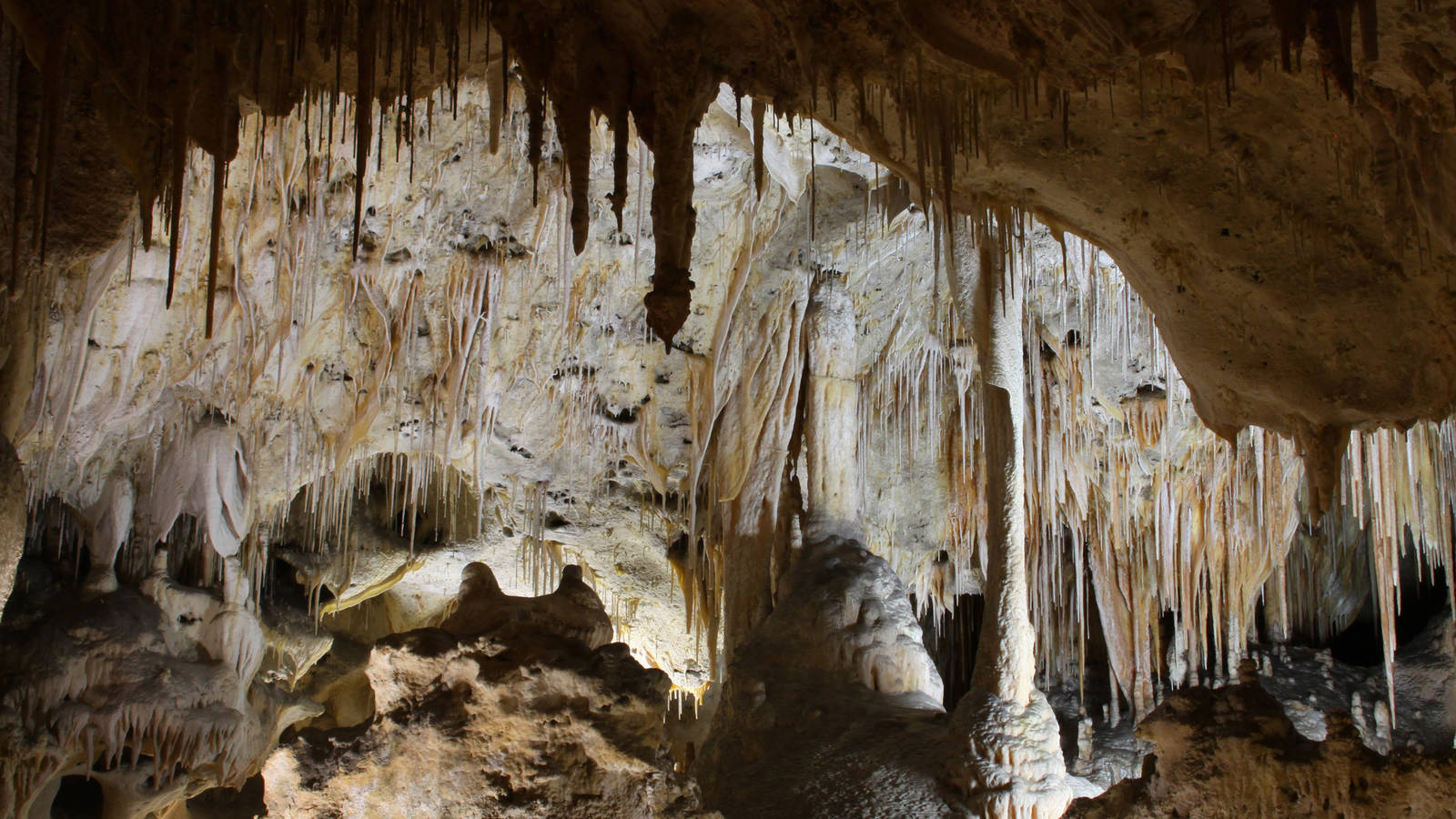
I have decided to use Veins of the Earth for this purpose. Mainly because I really, really love Veins of the Earth. I read it initially when it came out but then recently went on a trip to New Mexico where I got to visit Carlesbad Caverns. It was a truly amazing surreal and awe inspiring experience, I highly suggest that anyone who has the chance to go visit them. So overall I had caves on the mind.

Veins of the Earth doesn't have a strictly presented default style of play. But adapting it to be more of a megadungeon would involve hacking it in some ways. To this end I have decided to blog about it because, while I have read a lot of reviews about it and how amazing it is, I don't think I've seen any play reports or reports of how people made use of it in actually running a game.

And so we begin!

The Endless Descent...


One theme that I really loved about Veins in the Earth was the whole idea of the endless descent.
There is only the infinite darkness. But not the infinity of outer space, the infinity of endless cofined caverns, each a cloistering chamber, like room in a maze. Time has no meaning; dust could cover the floor, you could find a skeletal body with the trappings of those who lived 1000 years ago; the fossilized remains of something that lived a million years ago; or you could find freshly spilled blood, hear someone's last gasp echoing amid the rock. There is no regularity or consistentcy to time.

Space also has no meaning. Caverns go up, down, twist about, sometimes back upon each other. It's hard to know if you are heading towards a dead end, heading towards where the rock just gets narrower and narrower until you can't continue on but you see it continue before you like the tunnel of an ant. There is a strange dichotomy in caves: that sense of the endless, that each cavern you explore is another passageway, another space, stretches out endlessly; and a sense of the claustrophobic. It is very easy to get lost, very easy to forget that you are deep within the earth, that while the cavern may stretch out before you and seem endless, it is not the openness of outer space. Stone is unforgiving, unyielding. 

There is only the descent. Further, further, into the caves you go, sometimes up, sometimes down. The only point of reference you have is yourself, what you see, what you feel, what you sense or don't sense. You descend, down, down, down, what unknowns await you, you never know. The only way is forward, and to move forward is to move forever down. Past all structure, man and civilization has conceived for itself, deep into the bedrock of time itself. 

It was these themes, presented in the book, and from my own experiencing exploring Carlesbad Caverns, that I wanted to capture with my campaign. 

Cave System Generation Rules


In Veins of the Earth there are two different sets of rules presented for creating and traveling in caverns. One is a set of rules that creates a 'player level' cavern systems. Basically a grouping of caves that the players can explore. Like the weekly mini-dungeon or whatever. The other set of rules creates a more birds-eye-view wilderness type map that the players can use to travel across vast sections of the underdark.

To create my megadungeon I decided to use just the rules involved with creating cavern systems and ignore the birds-eye-view rules. I've modified the cave system generation rules a bit. I'll probably post it at some point when I refine them a bit more. Overall, as mentioned a bit in the above, I would be creating the megadungeon in a modular way. Each cavern system would have 3d6 caves and have a name/theme etc. Additionally each would essentially be the lair of one of the monsters presented in the first half of Veins of the Earth. It wouldn't necessarily be the only monster or enemy that the players would encounter in that cave system. But it would be the apex predator, where while they were in that system they would be on it's turf.

In essence in my underdark, there is no 'wilderness' in how we commonly think of wilderness in RPGs. There are only endless interconnected systems of caves. A natural megadungon. 


Cities and Civilization


Another thing that I wanted to change is how Veins presents cities and civilization. I didn't want the underdark just to be a upside down or shadow version of the surface. On the surface you have cities and villages and various peoples and a whole social structure. I didn't want cultures/civilizations to be arranged in a similar manner below where you'd have underground cities in vast caverns and trade tunnels instead of trade roads and stuff like this. 

The reasons for this are twofold. The first being that from a realistic point of view, it would be near to impossible to have underground cities. Due to the unique geography of caves, from a social and survival point of view, things would develop dramatically different. The most you could probably have are small bands of people. Things would be much, much more tribal. 

This fit well with my megadungeon idea. Where above all else I wanted the overall impression the players got, was to be of that of the mythic underworld, of endless descent. It's kind of hard to have the game embody this feeling if the players stumble across an underground city. The caverns begin to feel a bit less unknown and unmapped, a bit less wild and strange. Additionally, in megadungeons there are often different factions living in the mega-dungeon that the players can interact with. The idea of having no cities and instead scattered tribal groups of 5-15 individuals, who in a way are a lot like the players, exploring the underdark and trying to survive, fit well with this concept. The only difference between them and the players is they will have either simply been born in the underdark or been there much longer than the players.


Cultures and Races


It may seem natural to have the six cultures presented in Veins of the Earth to be the peoples that form the small tribal groups that are encountered. I decided against this.

The main reason I decided against it is that most of the prevailing mystery around megadugneons is who built them and how they came about. Where you delve deeper and deeper into them to find what lies at it's center, to find some answers to all the weird shit that seems to fill them.

With my underdark serving as a natural megadungeon, there would have no such 'builders'. I still needed some source of mystery though. Something or someone that would make the players want to continue delving to find out if they hold the they seek.

The main cultures presented in Veins of the Earth seemed to fit really well for this. They are presented in a really vague way that make them seem alien. They are also the masters of the underdark. They are the intelligent life that has survived the longest in it and adapted to it the most.

They would serve as my metaphorical 'builders' of the megadungeon. Additionally, they would also likely know routes back to the surface if the players wanted to find their way back there. While there is no explicit or set goal of the megadungeon, if the players wanted to answers to the mysteries they encountered while delving, they'd have to seek out one of these races. 

In this manner meeting one of these races would serve as the endgame for the megadungeon. As to what the meeting will entail or what the players hope to get out of it, or even which race they hope to meet up with, it's up to them.

So while they will encounter tribal groups in the underdark, none of them will be made up of the main cultures presented in Veins. Instead they will be made up of the more intelligent monsters, like the Funginoids, the Knotsmen, the Olm, etc. Or even other more solitary monsters as I tend to run my games where interaction besides combat is generally possible with all but the most dangerous or violent monsters.

The cultures presented in Veins instead would be presented in fleeting glimpses. Strange items found, escaped slaves who are insane, strange marking and writings, shadowy figures seen who appear to be watching, basically fragmented events or encounters which only serve to heighten the mysteriousness and utter alien nature of these cultures. 

Keeping direct contact and interaction with them as limited as possible until the endgame also helps to keep them alien. It's kind of hard to have something that the players encounter frequently; in combat, in parley, getting quests from, doing errands for, as alien. I'm going with the less is more approach.


The 4 Cultures 


In the end I decided on using four of the six cultures presented in Veins. The main reason is that four seemed a bit more manageable and some of them seemed to leand themselves more towards the less is more approach than others. I also wanted them to strongly contrast them against each other and four kind of fit well along the whole, good/evil/law/chaos divides that most RPG players know well. Having them contrast each other would force the players to make a meaningful decision about which race they'd like to try to contact and which they feel might be most likely to meet their objectives.

In order to have them encountered indirectly, rather than directly, I have modified the following four cultures in the following ways so I have more to work with in terms of dropping hints, shadowy encounters, signs and foreshadowing, etc.

dEr0


As presented in the book the dEro are paranoid dwarf like creatures skilled in strange, almost steampunk like technology, except heavily focusing on crystals and diamonds and other minerals and electricity rather than brass and steam. The players will find bits and pieces of their technology and gadgets scattered about. Periscopes watching them, be attacked by strange experiments gone wrong, find horribly mutilated and abused test subjects. Kind of like your mad scientist sterotypes with paranoia cranked up to 11. Like an Island of Dr. Monreau or Mysterious Island type situation.

As for the endgame what other fantasy creature tends to be solitary, is incredibly powerful, and often works it's will through intermediaries. Lichs! Often in their incredibly dangerous lich lairs which are mazes of deadly traps. 

Except instead of a Lich it's a dEr0. They're so paranoid they're inherently solitary (they trust other dEr0 the least of all) and build their lairs to protect themselves. Instead of having access to powerful magic, it's strange and alien technology. If the players want to talk to one thy are going to have to reach one at the center of it's deadly lair. Which will be an exercise in deadly mindgames as the dEr0 probably wants people to test it's defenses. So you kind of get around that whole problem of why the fuck would somebody build a deadly maze only to bait people into it problem that most deadly dungeons have.

 Imagine the dEr0 watching their progress and shouting at them constantly through some kind of intercom while they delve into it's maze. 

"AHA! YOU HAVE SURVIVED MY ELECTRIFIED FLOOR PANELS! I WANTED YOU TO SURVIVE MY ELECTRIFIED FLOOR PANELS. THANK YOU FOR TESTING MY ELECTRIC FLOOR PANELS. WHEN YOU WAKE UP FROM THE SIMULATION YOU WILL BE REWARDED. I AM NOT THE dEr0 YOU SEEK. I AM PART OF THE SIMULATION. THE OTHER dEr0 ARE PART OF THE SIMULATION. I AM THE OTHER dEr0. IF THE OTHER dEr0 SENT YOU THEN YOU ARE FAILING THE SIMULATION. HOW CAN YOU NOT PERCEIVE YOUR FAILURE OF THE SIMULATION. THE SIMULATION SIMULATES FAILURE TO SEE HOW THE SIMULATION CAN FAIL. YOU WILL FAIL THE SIMULATION. YOU MUST FAIL THE SIMULATION TO WAKE UP. THE SIMULATION CANNOT NOT FAIL."

Aelf-Adal


As they are presented in the book the Aelf-Adal in my underdark are elven creatures of immense hatred that is so self-contained it is as capricious as it is cruel. They are as likely to laugh their cold laughter, like the twinkling of sliver bells, as they are to slit your throat. Their motivations are utterly chimerical. They seem childlike in nature but are even more alien that this for even children have understandable, base motivations. The Aelf-Adal do not.

They are creatures of pure shadow. You don't hear or see them first. You sense them. Sense an immense hatred. It falls upon you oppressively. You look around lifting your lantern high, half expecting to see someone staring at you out of the darkness, or behind you, but there is no one. 

Sometimes this presence of immense hatred leaves and they are gone. Sometimes it stays, and you hear laughter like a cold sun that sends shivers down your spine. Sometimes you see darkness fluttering on the edge of your vision, like when you turn your head too fast and the image blurs. Someone falls down dead, their throat slit, a monster that you were fighting is disemboweled, a pile of pure white diamonds lie on the floor, a strange symbol is drawn in chalk.

The few who know of the Aelf-Adal know that during these moments, instead of looking around for them, if you douse the flame of your lantern, if you stand in complete darkness you can see them. They stand around you as black outlines, silhouettes of a deeper darkness in the black. Tall and elfin in form. You see them. If you talk to them they may answer. They may not. They may just vanish once they realize they are being observed.

The endgame for the Aelf-Adal would probably involve two parts. The first being finding something they desire. Some innocuous or strange item that it seems like no one would want. An ordinary boot on the skeleton of some long dead adventurer. A flower carved out of dimond. A beautiful purple mushroom that grows alone. And then finding some kind of portal or way to travel to their shadow realm so you can parley with their sexless and ageless Queen giving the item in return for something that you want. 

Dvargir


As described in the book they are work obsessed. They literally live to work. They build, they construct, and then once it's done they abandon it and move on. It's kind of suggested in the book that they build cities. Instead of cities, in my underdark, they build graveyards; mausoleum cities of the dead.

From birth every single Dvargir works endlessly on it's own tomb. They work until it is complete and then once it is complete they entomb themselves inside, lie down in their sarcophagus and close their eyes until they die. It is only when they lay thus, like the final capstone in an arch, is their work and life considered complete. 

Dvargir cities are cities of the dead. Streets laid out, flagstones laid, everything perfectly crafted, everything in perfect symmetry and style. Except instead of rows of houses or buildings you have mausoleums and tombs. Each doorway covered with Dvargir runic equations to protect the bones of those who lie within.

They probably carve their strange runic equations on the bones of lesser creatures to instill the undying will to work in them. To essentially keep them alive and working even when dead. To protect their empty and lifeless cities.

For the endgame the players are going to have to find one of these cities. It probably won't be extraordinarily hard. They're not kept secret. But they are seen as cursed places which are full of all kinds of weird and strange vengeful ghosts and undead. And if they want to talk to a Dvargir they are going to have to remove it's bones from it's tomb and conduct some ritual in the grand temple. A temple that is probably more like a Freemason temple than a church temple, if they want to raise it from the dead. 

I'd probably mix in a bunch of weird Masonic stuff into them and their runes to stop their rune magic from seeming too much like viking magic. Make their runes spell out mathematical equations. Mix in stuff like the whole Master Builder thing in Freemasonry and divine or sacred geometry where the universe is seen as being designed with divine proportions and if you can understand the divine math you can harness the power of god or something. They understand this sacred math.

Gnomen

Like in the book in my underdark the Gnomen are going to be free-spirited creatures that tend to live in the moment. I'm going to basically make them like your sprites or faeries of folklore.

They are diminutive in side. No more than 12 inches tall. You also hardly ever see them. Instead like the story about the cobbler where he wakes up every morning and finds all his shoes have been cobbled in the night and then stays up all night to see the faeries doing it and then they disappear and never do it again, the Gnomen are going to be like that.

The players may wake up and find their gear fixed. Or be stuck in a chasm and find a rope unfurling from above to help them but when they climb up find no one there. Or find miniature tools lying about at times. Or miniature clothing. The Gnomen are the only purely good culture of the 4. They'll be helpful to the players but incredibly shy. Only helping them in ways where they can avoid being seen and can probably turn invisible or something.

The endgame for them is they probably need the players to do something. Like their race is trapped or enslaved. Maybe not necessarily physically but they have been bound and enslaved in some way. They yearn to truly be free, to escape their bonds of slavery. But they can't act directly against whatever enslaves them. It's part of the geas upon them. So they have to act indirectly. To kind of do good things for the players and hope the players become interested with them. Give the players signs about their predicament and hope that the players kind of figure it out and solve the riddle that they need to solve to free them and defeat whatever enslaves them.


The Knotsmen

I know I said I'm having only four major cultures that serve as the dungeon 'builders' and a source of the endgame, but the Knotsmen deserve special mention as they will be the glue that kind holds a lot of it together.

Like in the book they are obsessed with debt, never give anything away for free, and inherently untrustworthy, etc. In my undedark they are essentially the main merchants/sources of information. You don't encounter villages of them or even tribes. You only encounter they individually, and never encounter the same one twice (although they look similar). But they all seem to know about your previous encounters and dealings. If you kill one and encounter another, no matter how well you covered up the murder, the next ones will know. They may not care, probably won't care, but they know.

They always travel about on skiffs and are always encountered on bodies of water. Underground rivers, lakes, pools etc. They seem to use these waterways to travel about although it's never seen how and they never offer to take the players anywhere. They always have items for sale or barter, sometimes mundane, sometimes magical, and always information to sell. If the players want to get info about the 4 main cultures, the Knotsmen are an excellent source.

They never give anything away for free. Additionally they refuse to sell or barter anything that the players desire most. No amount of money or promises or anything will sway them. They will only provide what is most wanted for debt: they will give you what you want but someday, someway, they will come to collect upon that debt. What that debt entails is largely ambiguous but if the players roleplay it well enough the Knotsman may agree to conditions. If they agree to conditions they will always try to cheat them. They are kind of like a combination of the devil at the crossroads and Charon the ferryman

They probably show up every session or two. As I'm doing the underdark as a megadungeon and the players are stuck in it, there will be no opportunity to exit the megadungeon and go back to the nearby village to rest and buy stuff as there is in most megadungeons. Instead the players are essentially trapped in the megadungeon. The Knotsman can essentially provide the services and actives the players would normally do in town and serve as a reoccurring or familiar point of contact this way. 


Monday, 15 January 2018

Lamentations of the Flame Princess House Rules


I've been working on these house rules for quite a while. They come after about a year of playing the game. They're for Lamentations of the Flame Princess as the title indicates. Overall while they change some sections of the game drastically, I try to stay true to what I consider to be the spirit of LOTFP and simply refine existing ideas or fill in gaps with new ideas. They also incorporate all my changes to the classes that I've blogged about before.

Without further delay here are my house rules:

The Luminescent Lich’s Lamentations of the Flame Princess House Rules v1.0


You can comment on the google doc. Please comment if you find any mistakes or imbalances or other issues. These rules very much are a work in progress.

Also, some of these ideas may have been based on ideas that I've read previously in various RPG blogs. I have done my best to cite the original author and blog when I can remember/find them. If you feel like I have forgotten you and want to be properly cited, let me know.

Tuesday, 26 December 2017

Hacking LOTFP Classes Part 7: Putting Everything Together

This is the seventh and final part in an article series examining the LOTFP classes in order to design new ones. Part 6 is here.


So far in this article series I have spent a lot of time examining how classes function and work in LOTFP and OSR games in general. I have:

  1. Started with four elements of class design;
  2. Elaborated on the 6 different encounter types and matches them with 6 different classes;
  3. Talked a bit talked about base abilities and matched them with the classes;
  4. Examined the gameplay subsystems that make up LOTFP;
  5. Elaborated on class design ideals; 
  6. redesigned the cleric class.
I have yet to really delve into the nitty gritty of tearing apart and redesigning the classes in Lamentations of the Flame Princess. Now no longer! I shall get into the thick of it! I will try to be brief and hope that previous articles will give insight into my design decisions.

Core Parts of a Class

As outlined in the first article, in terms of the crunchy rules orientated parts of a class, I think there are two major elements of a class: 

Mechanical Bonuses: these tend to be things that any character can do but which the class gets a bonus at doing. These are generally numerical modifiers that rise as the character rises in level, things that are added to dice rolls to make a class thematically better at certain activities. It is stuff like the Fighters increased bonus to successfully hit in combat over other players in LOTFP. All players can fight, but generally the fighter is the best at it, etc.


Class abilities: these are parts of the game that are designed specifically for the class. They tend to be little subsets of the rules and tend to be things that only that class can do or only the class gets significantly better at in time. The Magic-Users ability to cast spells or the Specialists skills are examples of this. Additionally these subsystems tend to have unique mechanics when compared to each other. For example specialist skills function totally different than magic-user spells mechanically. You could resolve both with roll under X on a d6 but overall I feel like classes feel more unique and organically designed if their subsystems have unique mechanics.


As I detail the classes each one will largely be comprised of two sections that mirror the above distinctions. Before I start getting into details, lets continue building our chart so we have a bit of a birds eye view:


Encounter Type
Class
Ability Score
Mechanical Bonus (scales with level)
Class Ability
(unique subsystem of rules)
Combat
Fighter
Strength
Base attack bonus scales with level
Unique Fighting Styles
Trap
Thief
Dexterity
Skill points for specialist skills per level

Hazard
Ranger
Constituion


Trick
Wizard
Intelligence

Magic-User Spells
Anomaly
Cleric
Wisdom

Cleric Spells
Social
Bard
Charisma


Now I have filled in the above chart as it pertains to the current LOTFP classes. As you can see there are some gaps and two new classes entirely, the Ranger and the Bard. This kind of begs the question of does LOTFP need these classes? 

Overall I think yes. 

In terms of the 'Bard' there is a fair amount of social interaction in the game, due to the players being investigators at times where they're investigating what is going on and having to talk to NPC characters and piece together information. Additionally there are several gameplay subsystems, such as hiring and dealing with retainers, which I think would make for excellent class material and get the players to use those systems more.

In terms of the 'Ranger' after playing LOTFP for about a year I have found that people tend to double up on the Specialist class where very often the players will coordinate a bit so that two basic Specialist builds emerge; one leaning more towards being a typical thief, and one leaning more towards bushcraft--basically a ranger. 

The Ranger and Bard aren't new classes in the RPG world by any means. They have both been around for several decades. Instead of calling them Ranger and Bard, which would be a bit out of place in LOTFP’s setting I have imagined their concepts as such:

The Explorer

The ‘Ranger’ class is called the Explorer. They are an outdoor specialist, a loner who is good at hunting and skilled with firearms. They come from a more lower class background, usually having grown up in a rural setting. Explorers around the globe are discovering and opening up new lands. The Explorer class is not a big name explorer of history, at least not yet. They are a commoner who has decided to risk everything in an expedition or two either as part of a newly formed adventuring company, or having returned from an expedition and narrowly survived. 

The Courtier

The ‘Bard’ class is called the Courtier they have excellent leadership qualities and excel at leading others. They come from a more middle or upper class background, usually educated and trained in etiquette and the pastimes of the upper class such as hunting and riding. While they may seem well off, and are compared to your average commoner, their position in life is far from secure. They're family is well connected enough to be seen a member of the upper class, but not well off enough to be above or immune from the petty squabbles, backstabbing, ass-kissing, poisoning, blackmail, feuding, and other intrigue. 

The character may or may not have a title and their family usually has an estate but there are many people in line for the inheritance of it. Through their family connections and wealth the Courtier has been able to find themselves a position leading others in some major institution, perhaps belonging to the state like an officer in an army, trading company, hospital, etc. or perhaps a privately owned venture like mining or textiles. Overall they have a family name but have yet to amass any great personal power or wealth, at least not yet. They are essentially a front line manager, the person that all those high up in the institution send to attend to whatever situation or crisis that is currently going on in which they need someone at ground zero to handle something fucked up. 


Classes

Fighter
Ability Score: Strength
HD: 1d8

“Slaughter defines man’s history. Every new era is defined by the cruelty man inflicts upon man, or the victory fighting against it. To those in power, soldiers are but tools to shape the populace to their whims. The price that is paid to enact their desires is irrelevant to those giving the orders. In battle, there is no law. Man maims man. Horribly wounded men scream for mercy as their life’s blood pours out from cruelly hacked wounds. Their cries are ignored and their lives extinguished by those too cruel or frightened to listen. Poets and politicians speak of the honor of battle for a just cause, but in battle there is no justice. There is just death from metal implements that crush, slash, and stab. To be willing to slaughter at another’s command in the name of peace and nobility, to be hardened to the deaths of loved companions, to be immersed in this worthlessness of life, that is the life of a soldier. Fighters are these soldiers that have seen the cruelty of battle, have committed atrocities that in any just universe will damn them to Hell, and have survived.” -- LOTFP core rules.

Improved Melee Attack Bonus: the Fighters melee attack bonus (and only melee attack, not ranged) improves as they level like it currently does in the core rules. Except the bonus is calculated simply by adding their level to their strength modifier. For all other players their melee attack bonus it is their strength modifier.

Combat Options: the existing combat options have been modified to depend on the weapon setup that the person is using . The Fighter is essentially an expert in weapons and how to fight effectively with them. They are the tools of the trade for them. Anyone can can use a mace to flail at someone, but it takes someone really skilled and trained to know how to strike effectively with it. In this manner while all classes receive a bonus for certain weapon setup’s, the Fighter receives an additional bonus.


Combat Options
Style
All Classes (including fighter)
Only Fighter
Weapon and Shield
+1 to AC
Defend: +2 AC against ranged attacks.
Weapon in one hand. Other hand empty.
-
Rush: +1 to group initiative. 
Weapon in each hand (must be small or minor weapons).
+1 to attack
Press: roll both damage dice and use whichever is higher.
Great Weapon
Max weapon damage on natural 20.
Batter: each successful attack reduces enemy's AC by 1.

The reason I have combat options depend on weapon setup is because I find most players tend to forget to use the special moves available to them in combat, partially because LOTFP combat tends to be fairly short and abstracted. In my opinion it should remain short and abstracted. I don’t like to have a laundry list of moves a character can do in combat as I find it goes unused or it slows the game down.

As a conscious game design decision I think combat itself shouldn't be tactical because the game’s focus isn't on combat. Players should often seek to try and avoid combat. However, preparing for combat should be tactical. Thus before combat the players can decide what weapons they are going to use and how they are going to approach a fight if they want a specific bonus.

Combat itself is basically a frantic, terrifying, and bloody slugfest to me. Both sides quickly wail on each other until it’s become pretty clear after a few rounds that either you’re going to kill the other side or need to run away.


Specialist
Ability Score: Dexterity
HD: 1d6

“Whether inspired by greed, boredom, or idle curiosity, Specialists are professional explorers risking life and limb simply because a less active life is distasteful to them. In some ways this makes them the only sane and normal adventuring characters, but in other ways it makes them the most unusual.” -- LOTFP core rules.

Improved Saving Throws: the Specialist, being a resilient and hard to kill professional who is cunning and cautious in equal parts, is the only character to have their saving throws improve over time. All characters start with saving the following scores that they can assign to whatever saving throws they wish (18, 16, 14, 12, 10). At each level, including first, the Specialist receives 2 points to add to whatever saving throw they desire.

Specialist skills: the Specialist uses the same type of skill sub-system they do currently but with more sneaky type skills:

  • Tinkering: as it currently exists in the core rules. Deals with mechanical devices such as traps. 
  • Stealth: as it currently exists in the core rules. Deals with going about undetected.
  • Backstab: as it currently exists in the core rules. Deals with attacking with surprise and doing bonus damage because of it. Each pip serves as a damage multiplier. 
  • Misdirection: replaces sleight-of-hand and meant to broaden the skill from just pick-pocketing to encompass other hustler/swindler type activities where the character seeks to distract someone while they do something. 

All other classes receive 1 pip in them at the beginning of the game and they remain at 1 pip. The Specialist receives a number of pips equal to their dexterity modifier at the beginning of the game and at each level, including first, they receive one pip to add to whatever specialist skill they desire.


Explorer
Ability Score: Constitution
HD: 1d8

“A new world lies before you. Lands opening up with riches to plunder. Ancient dynasties and kingdoms being toppled. New lands filled with new people and cultures, some abhorrent, and strange. Opportunities abound for even the most lowly to make their name and fortune. The world is full of dark wonder and only the hardy survive it’s travails. Sailors dying of scurvy in foreign seas, cartographers dying of thirst in some far off desert, porters and pathfinders dying of malaria in the blackest jungle. Explorers are these lowly individuals who have decided to seek their fortune in the wilds of a new world.”   

Improved Ranged Attack bonus: Explorers are the only class whose ranged attack bonus improves over time. It is equal to their level plus their dexterity modifier. For all other classes it is equal only to their dexterity modifier. In this manner the Explorer is a bit like a ranged version of a Fighter. They can become firearms experts where they are good at shooting from ambush or getting a volley off before closing in and attacking. They have the same HD as a Fighter but no scaling melee attack bonus so while the can take some damage in close quarters they are not great at prolonged fights.

Explorer skills: the Explorer uses the same type of skill system as the Specialist but has more wilderness type skills and a firearms skill:

  • Trapping: craft or set up traps, tracking, knowledge of habits and handling of animals and local flora and fauna.
  • Bushcraft: functions the same in the core rules. Used to survive in wilderness, find food and water, and construct a shelter, knowledge of local terrain, etc.
  • Traverse: able to traverse rough terrain including swim across fast moving water, climb rough rock walls, clear rockfalls, walk along narrow ledges, navigate through rapids on a boat, and set up specialized equipment in order to help others traverse terrain. Such as constructing a rough rope bridge or setting up rope for descending or ascending.
  • Firearms: knowledge of firearms, their use and maintenance, and experience and skill in them. I have changed how reloading firearms work in combat. On a character's turn they can make a Firearms skill check to see if they are able to reload. If they fail they can try again next turn if they wish. They can also make a Firearms check in combat to try and hit a specific target in melee. If they fail who they hit is randomly determined.

All other classes receive 1 pip in them at the beginning of the game and they remain as 1 pip. The Explorer receives pips equal to their constitution modifier at the beginning of the game and at each level, including first, they receive one pip to add to whatever Explorer skill they desire.


Magic-User
Ability Score: Intelligence
HD: 1d4

“Most of the world lies sheltered from the existence of magic, encountering it only as it victimizes them. They huddle in their churches for comfort and trade their freedom and dignity to a ruler as they beg for protection, all for the fear of the supernatural which they do not, and cannot, understand. Magic-Users choose a different path. Instead of cowering away from the darkness, they revel in it. They see the forces of magic as a new frontier to explore, a new tool for the attainment of power and knowledge. If it blackens the soul to equal that of any devil, it is but a small price to pay.” LOTFP core rules.

Improved Cast Spell: for magic I’m using the leveless spell system described Vagina's are Magic with an added 'Cast Spell' score and the change that all characters are able to cast spells from scrolls if they have a high enough Cast Spell score.

All characters have a Cast Spell score. However Magic-Users are the only class who’s Cast Spell score improves over time. When a character casts a spell (either from scroll or spellbook) the level they cast it is equal to it's Cast Spell score. For Magic-Users their cast spell score is equal to their intelligence ability modifier plus their level to their Cast Spell score. For all other characters their Cast Spell score is equal to their intelligence modifier.


Spellbook: the Magic-User starts off with a spellbook with 1 + intelligence modifier randomly determined spells. They also gain one randomly determined spell per level. They are the only character who is able to transfer spells from scrolls to spellbooks and thus can permanently learn more spells. All other characters can only cast spells from scrolls.


Cleric
Ability Score: Wisdom
HD: 1d6

“Some religions teach the people how to receive the grace of their loving deity. Some religions teach the people how to survive the wrath of a cruel and vicious deity. Some religions simply strive to teach the truth about creation. All religions serving true powers have one thing in common: orders of those selected few who are not mere priests, but spiritual warriors endowed by their deity with mystic powers. These few are known as Clerics.” -- LOTFP core rules.

Improved Lore: Lore is a new score that I have added to determine a character's knowledge of the otherworldly, supernatural, strange, weird, or anomalous. A successful Lore roll gives a character information about what might be going on or an inkling of a danger they may face. For a full explanation of how Lore is used see the Lore section at the end of this article.

I view the Cleric, who is a scholar of the church and has read the chronicles of missionaries to strange foreign places, and has faith in the supernatural, an expert in Lore. Unlike the men of reason of the enlightenment, the cleric has faith in the unseen and knows that evil can take many strange forms. Their Lore score is equal to their level plus their wisdom modifier. For all other classes it is equal only to their wisdom modifier.

Relics and Piety: I don’t use a leveless system of magic for the cleric like I do for the Magic-User, instead I have reworked the clerical system of magic with the inclusion of Piety and Relics. Piety functions kind of like hit points. The cleric has a current level of Piety and a max piety. A cleric's max piety is equal to their wisdom ability modifier plus their level.

Piety can be gained and lost by the cleric committing immoral/moral actions according to the their religion. For a cleric to cast a spell it costs 1 point of piety. They get one point of piety a day by taking the time to meditate and pray to their deity.

Clerics don’t have holy symbols. Instead they have relics. In order to cast a spell they need to be cast through a relics, where the cleric is invoking the miraculous nature of the relic. For the reasoning behind this see the Piety and Relics section at the end of this article. The cleric starts off the game with a tier one relic and each tier of relic grants access to an increased level of cleric spells. As long as they have their relic they can invoke it’s miraculous nature and cast any cleric spell from it’s level or below on the cleric spell lists in the core book.


Courtier
Ability Score: Charisma
HD: 1d6

“You are the middle child of society. Not high born enough to have your position ensured, not low born enough to live the simple common life, what privileges your noble birth has afforded you have granted you with many more difficulties and complications in turn. Complications and difficulties that are often deadly as those of more noble birth around you fight for power and command you to take care of all the details of their plans and involve you in their endless power plays.”

Leadership: to help facilitate social interaction in the game I have implemented a leadership score. Leadership is used by a character when they try to rally their comrades to make a monster run away in combat, to determine NPC reaction, and in hiring Hirelings. For full details of how it all works see the Leadership section at the end of this article. A characters leadership score is is equal to their level plus their charisma modifier. For all other classes it is equal only to their charisma modifier. Additionally Courtiers receive one free hireling at level 1 that has no monthly cost.

Insight: the Courtier has had many years of practice of dealing with people, sensing their motivations, and sussing out information through gossip, spies, and bribes. They have become very insightful and whenever they encounter another NPC for the first time (be it a monster they can bargain with in a dungeon, a King in a throne room, or common peasant on the street) they can ask the GM to answer a number of the following questions equal to their level. The Referee must answer truthfully as the NPC would know it to be true (although they can be curt in their answer) and must answer regardless of how the NPC feels about the Courtier or the party:

Courtier Questions:

  • What does this NPC fear the most?
  • Who is this NPC greatest ally?
  • Who is this NPC greatest enemy?
  • Who does this NPC love?
  • What does the NPC treasure above all else?
  • What is the most valuable thing the NPC possess?
  • What event in their life will the NPC never forget?
  • What would the NPC like to achieve?
  • Who does the NPC want revenge on?
  • What does the NPC delight in? 


New Systems


Relics and Piety

Piety: As previously described in the description of the Cleric class Piety functions kind of like hit points. You have a current level of Piety and a max piety. A cleric's max piety is equal to their wisdom ability modifier plus their level.

Piety can be gained and lost by committing immoral/moral actions according to the cleric's religion. The cleric gets one point of piety per day when they take time to pray. Piety can be spent to cast divine spells from relics where each spell costs a point of piety. When a cleric is out of piety they can no longer cast spells.

Relics:  the reason I have clerics cast spells through relics in my game is because the source of the clerics magic has always felt a bit at odds with LOTFP real world 17th century setting to me. I have clerics invoke their magic through relics because clerics are not special people with some kind of innate or holy connection to the divine. They are instead your average village priest. However, there are people who do have an innate or holy connection to the divine, saints. When they die they leave behind relics, and these relics can be invoked by a member of the clergy to perform miracles. I did not come up with this idea. I got it from Burgs & Bailiffs: Trinity - The Poor Pilgrim's Almanack.

Types of Relics: in my game there are 7 tiers of relics. They are loosely based off of the actual Catholic church's organization of relics.


Relic/Spell Level
Description
1
Any object that is touched a relic of greater importance. Most of these relics are small pieces of cloth, though in the first millennium oil was popular and some reliquaries have holes for oil to be poured in and out again. Many people call the cloth touched to the bones of saints "ex brandea".
2
Items that the saint owned or frequently used by a saint, for example, a crucifix, rosary, book, etc. Sometimes part of an item that the saint wore (a shirt, a glove, etc.) 
3
The physical remains of a minor saint who lived an exemplary Christian life. 
4
The physical remains of a saint who lived an exemplary Christian life and died for their faith as an important martyr. 
5
The physical remains of an important saint, generally an: influential theologian, a royal who was a defender of Christianity or who converted his kingdom to Christianity, or the first missionary to successfully spread Christianity to a new region. These reclis tend to take the form of the saints status in life. For instance, King St. Stephen of Hungary's right forearm is especially important because of his status as a ruler. A famous theologian's head may be his most important relic. 
6
The physical remains of one of the twelve apostles or an important biblical figure, generally alive during the time of Jesus.
7
Items directly associated with the events of Christ's own life (hay manger, bits of cross, shroud, sandals, foreskin). 

Gaining new Relics: a level one cleric would start the game off with a level one relic that would grant them access to their first level spells. As they grow in level if they want access to their higher level spells they are going to have to find a new relic, either through theft, reward, or seeking out a lost or stolen relic. It is also important to remember, that during this time relics were often an important source of income and prestige for a church. Their theft would be considered sacrilegious and the relic would be considered a ‘hot’ item. The church would likely pay people to track it down and retrieve it.


Lore

To me, with the style of the adventures, and advice given in the Grindhouse Referee’s Book,  LOTFP is a slightly different different game from your typical OSR D&D game. Due to the influence of horror and weird literature and film, I find LOTFP to be a bit more of an investigative game. At the heart of each adventure there is generally something horrible and weird that has happened or is happening. This often forms the situation which the players are exploring as part of the adventure.

I see the characters as investigators, in the same way that if you read the classic Dracula, all the characters in it are trying to piece together their various accounts, old myths and legends, and other information, in order to destroy Dracula. To help facilitate this I have introduced the Lore score.

I view the Cleric, who is a scholar of the church and who has read the chronicles of the church about strange foreign places, devils and demons, etc. and has faith in the supernatural, an expert in Lore. Unlike the godless men of science who look down upon the supernatural with disdain, or refuse to believe it outright. The cleric has their faith in the unseen and knows better than to assume that rationality alone can prevail against the evil things which reside in the darkness. A Cleric's lore score is equal to their level plus their wisdom modifier. For all other classes it is equal only to their wisdom modifier.

Using Lore: whenever a player encounters something that is otherworldly, supernatural, strange, weird, or anomalous; be it a creature, place, object, person, etc. They can make a lore check by asking a question and rolling 1d20 and adding their lore score. The question can be really general, such as; “does my character know what cult this symbol belongs to?” to something really specific; “Do I know what is a weakness is for those strange insect creatures from another planet?”

The Referee then comes up with a target number based upon their question and the following chart:


Question
Target
Basic or general information that the populace of the area would know but the characters do not.
5
Information that a few old wise people would know, or could be found within a few musty tomes.
10
Very specific information, either largely lost to time, existing in one source such as a single book looked away, or something that only a few living people would know.
15

The Referee does not tell the player the target number they have to roll above. If the player successfully rolls above the target number the Referee answers their question. If the player fails their lore check then the Referee still answers their question but is free to falsify as much or as little of the information as they wish. Knowledge of the world during this area is not perfect and very often there is a lot of false information found in the myths, legends, and lore that may surround something.

Furthermore, in either case, success or failure, the Referee is encouraged to make things up and improvise upon whatever material they are using to run the adventure. For example if a player asked what the insect creatures secret weakness was and they rolled a 20, but the insects don’t have a weakness the Referee is encouraged to make one up such as the insect creatures have a weakness to cold because they come from a really hot desert like dimension as described in the writings of a mad desert hermit who saw them in his dreams. Let the game take a new turn in this manner.

The lore check doesn't determine how much information a player gets from a Referee. It only determines how much of that information is true and how much is false. Regardless of the roll a a Referee must give out a few facts in response to the players question.

Astute players will probably realize that in general if they roll high in their Lore check, and ask basic questions, the information they receive will probably be factual. The Referee shouldn't hide this from them and should explain the Lore rules to them when they make a check. Overall a Lore check isn't meant to be an opportunity for the Referee to screw over the players (although it can and should happen at times). Overall, players should want to use their Lore ability. The Lore mechanic is meant to be a collaborative mechanic that helps facilitate the referee sharing information with the players. It serves as a way for them to give information to players in bits and pieces, rather than all at once such as having an NPC tell them everything about something. By making it more player facing, and player driven, it allows players to get information at their own pace as they investigate things. It also tries to keep things lively and interesting through having the lore of the game made through play and it being somewhat unpredictable and reflecting real world circumstances.


Leadership

Instead of having three separate subsystems to handle most social interaction type stuff (monster morale, hireling loyalty, and NPC reactions) as outlined in the core rules, I have rolled all of them into the following chart and leadership mechanic.

Each character has a leadership score. For the Courtier it is equal to their charisma modifier plus their level. For all other classes it is equal to their charisma modifier.


3d6
Morale (Enemies)
Loyalty (hirelings)
Reaction (NPCs)
3
Fight (50%)
Flee (9.25%)
Trecherous (1.84%)
4
5
Hostile (7.39%)
6
7
Shaken (40.75%)
Rude (16.66%)
8
9
Distrustful (24.07%)
10
11
Flee (50%)
Steadfast (40.75%)
Welcoming (24.07%)
12
13
Talkative (16.66%)
14
15
Brave (9.25%)
Helpful (7.39%)
16
17
Enamoured (1.84%)
18

Each column on the above chart is rolled on under different circumstances to determine how something reacts and the characters Leadership score is added to the roll.

Morale: a player may attempt to frighten away an enemy or enemies in combat when it looks like the enemy or enemies are beginning to lose. To do so the Referee rolls 3d6 and adds the players leadership score and subtracts the enemies Hit Dice. If a morale score is given for the enemy in published material (generally a number from 1 to 12, with higher being better) divide that score by 2 and subtract it from the roll.

Loyalty and Hirelings: when hirelings are hired they Referee rolls 3d6 and adds the characters leadership score. If the roll is above the middle line the hireling accepts the job, if it is below, they don’t accept the job. Paying additional money can give a character a bonus to the roll. The result of the roll, beyond being above the line, determines the hirelings starting loyalty.

Testing Loyalty: Whenever a hireling is put in danger or their loyalty is tested a roll is made. If it is in any category above their current loyalty, their loyalty moves from their current loyalty to the one directly above it. If it is any category below, they move from their current loyalty to the one directly below. As indicated, if it moves to the bottom most category the hireling flees.

NPC Reaction: every time the players engage socially with NPCs, be they beggers or be they kings, the chart is rolled on when the player first encounters them to determine their beginning disposition. Yes this can drastically affect entire adventure hooks where a King that was supposed to be friendly towards a player to give them a quest, turns out to hate them. Or a character who you wanted to be a treacherous bad guy actually falls in love with a player. This is meant to keep NPCs unpredictable and stop them from being simple walking billboards of information or quests. By making the reaction random and not having a neutral reaction, it forces the Referee to come up with motivations for why an NPC is reacting that way towards the players when first meeting them. This makes the NPCs more lively and interesting. Maybe the King hates the players because they’re common filth, maybe he hates them because he’s heard about how they epicly fucked up their last adventure etc. It also forces the players to actively engage with the NPC if they seek to improve the NPCs starting disposition or want to avoid it changing.